Wednesday, August 23, 2017

Will the World Forgive?


In America we live in bubbles.

One bubble rolls its eyes every time the President opens his mouth, wondering where the truth lies.

The other bubble stands and cheers every time he pushes a world leader out of the way.

Outside our borders and beyond our walls the world seems to have made up its mind.

Every time I talk with someone from another country they trip over themselves to find a way to bring up the topic of President Trump.  It often begins with: "You didn't vote for him, did you?"

In London they seem mildly embarrassed for us, as if something bad happened to a friend. They mumble something about Brexit, but the tabloids are unforgiving.

At a restaurant in Italy, when they learn you are from America, they launch into a re-telling of some story about Silvio Berlusconi as if to say:  "I understand."

In a cab in Croatia talk turns to politics and Washington and the state of our United States.

As the storm raged in Charlottesville and the President wondered aloud whether the KKK or the anti-KKK protesters were at fault, the cabbie's mood brightened when we told him we were from Washington, DC.

He was kind to us, but must have marveled at our astonishing lack of knowledge about a war that occurred in his backyard during the Clinton Administration.

But he wasn't judging us on that.

"Trump is a joke," he said in an accent that sounded like Vladimir Putin.  "But don't worry, America is still the greatest country in the world."

"Why do you think that?" I asked, "I mean with all that's going on?"

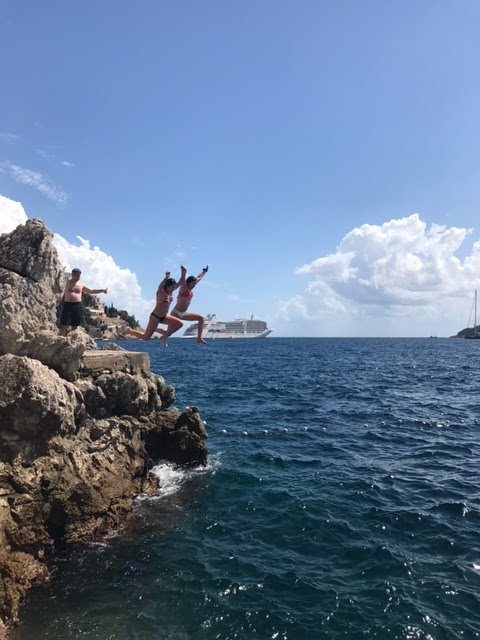
"We learned at an early age that America is the greatest country. The greatest economy and strongest military," he said. "During the war there was an aircraft carrier right out there," he said, pointing to the perfect blue of the Adriatic Sea. "That makes an impression on you."

"And the impression isn't ruined by President Trump?"

"This is a blip," he says. "Trump is not America.  One mistake does not ruin your greatness."

Days later a chef on the island of Hvar is, to me, remarkably fluent in the issues of Trump, North Korea and Hillary's email server.

"So what do you think?" I ask.

"You have a child running your country," he said. "On election night we were watching and couldn't believe it. Lots of countries are making this mistake, but America?"

"So does this make us like everybody else?" I asked.

"People here were laughing at first" he said.  "But now we are worried.  Maybe you can't control him."

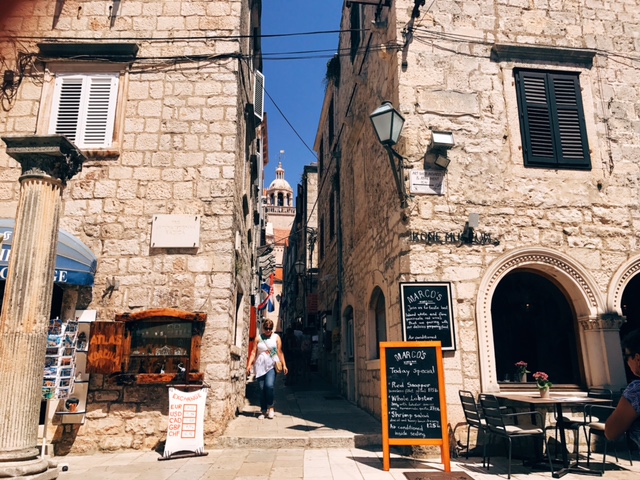
Croatia is a long stretch of land, including 1200 islands, just the other side of the Adriatic from Italy.  A beautiful country of people who spend their summers on the coast taking care of tourists and their winters inland making money.

At a small restaurant on a tall narrow side street a family gathers for lunch. The family includes the restaurant owner, his wife and two grown children, a grandchild, two cousins and some employees. They eat a stew of leftovers, drink some wine and smoke cigarettes. They talk and laugh, and talk and laugh, until they are interrupted by a potential customer.

When the customer asks for a table the owner looks at his daughter, both award-winning chefs, they shake their heads. Better to stay closed rather than interrupt the family lunch.

"It's the Mediterranean way," the old man says, before telling his grandson to put his phone away.

On a recent call with a colleague from Hamburg Germany the discussion turned from business.

"Can we talk Trump for a minute?" he asked.

"Do you think America can recover from this?" I ask.

"Well," he said after a long pause. "I come from a country where we too were embarrassed by our leader.  America will be back."

"How do you know?" I ask.

"Here's what I've learned," he said, "the world forgives."

But it doesn't forget.


Thursday, August 10, 2017

Fake News in a Real World: What It Means for Market Research


There is a famous New Yorker cartoon with one dog sitting in front of a desk-top computer telling another dog:  “On the internet, nobody knows you’re a dog.”

It appeared in 1993.

And now 24 years later the problem of internet identity has moved from a punch line to the front lines of business, news, politics and commerce.

The sad truth is that in 2017 on a Google results page, we all look the same.

On the internet we don’t know if a world super power hacked an election, or as President Trump said, it could be “Somebody sitting on their bed that weighs 400 pounds.”

On a Google results page, where many business decisions are made, an unsuspecting consumer doesn’t know if you are a PhD who spent 400 hours analyzing a market or a recent graduate putting together numbers from a press release.

In the world of the New Yorker and dogs trying to pick up cats, it’s humorous.

In a 24-hour news cycle, it’s sobering.

In a business where trustworthy information is the coin of the realm, it’s industry-altering.

Why do we all look alike?

Historically, one way to show you were a reputable company was to brag about your resume, highlighting the top companies you serve.  In this new world you don’t need to really have them as clients; instead, you copy their logos from other websites and post them.

Another way to show you are reputable is to prove your US bona fides.  But instead of having an actual office now all you need is the address of an office share and suddenly you’re in Albany.

Another way to prove trustworthiness is a show of force on LinkedIn.  Now these questionable firms post fake identities and histories with head shots of unsuspecting strangers.

Since 2001 MarketResearch.com has sold information for more than 1,000 publishers from around the world.  We sought out new publishers, new titles and curated them in a way to help make buying expensive industry analysis easier.  Our first tag line was “Helping you find the market research you need,” because we knew that nothing felt worse than buying a $5,000 study and not getting your question answered.

What is relevance in the age of Google?

Relevance used to be the best report that answered your business question.  Now when a reputable publisher comes out with a report, a fake publisher can produce a slim volume with the same title a month later.  When a business user searches Google, the more recent title often rises to the top.   

When there is no apparent distinction between what is inside a report, all you can do is judge a book by its title.

As good data, or hard news, become watered down, client expectations change.  When a news headline turns out to be inaccurate, people begin assuming all news must have something wrong with it.

We face the same challenge in the information space.  We can suggest that a client buy a $5,000 study because it was written by an industry analyst who studied the market for 30 years and is an industry expert.  But too often that same client opts for a less expensive report published by a new firm with no track record.  When asked why the client will use the dangerous phrase:  “Well, good enough, is good enough.”

My response to that client is:  Expect more.  Ask questions.  Don’t rely on a clever title and a well-crafted marketing email.

There is a way to conduct accurate research.  Try reading a study on the US market for packaged goods that was written by a person who never stepped foot in a US grocery store and the difference is painfully obvious.

Fake news and alternative facts, while a problem for our democracy, can be ferreted out by choosing where you get your information. 


But when you need to make informed strategic business decisions, good enough is not good enough. In fact it’s risky. You need accurate information from a reliable source. 

Wednesday, February 15, 2017

Five Oh


No I don’t want to be 21 again.

But I want to remember what it felt like.

Not because it was perfect, but because the farther away from it I get, the more it fades.

Anna Quindlin once wrote :

I did not live in the moment enough.  This is particularly clear now that the moment is gone, captured only in photographs. There is one picture of the three of them, sitting in the grass on a quilt in the shadow of the swing on a summer day, ages 6, 4 and 1. And I wish I could remember what we ate, and what we talked about, and how they sounded, and how they looked when they slept that night.

But I knew this.  I kept a journal and wrote down so much.  But I don’t remember what it was really like.  I’ve tried to stop the clock, but you can’t even catch it.

Life is With People is a study of the culture of the Jewish neighborhoods of Eastern Europe, the Shtetl.  The book attempts, not only to describe life in these communities that no longer exist, but recreate them.  They take the reader through the rhythms and sounds of the week, trying to reconstruct daily life.

The Introduction to the book describes its task this way: 

Like a dance, for which the music and the choreography have never been written down, a great part of any human culture is lost to humanity when the group which has carried it, devotedly, in every word and gesture dispersed, or destroyed, or forsakes the traditional way for ways which are new.
It is the same for every culture and community we have been a part of:  The house we grew up in, the fraternity we lived in, the place our kids called home. Every dinner table has similarities and differences from those before, but none are exactly the same.  

We were taught, inculcated, at 800 Lincoln to learn and live as the Men of the Mu did before us.  That house had a smell and a rhythm that existed while those 50 boys lived there, but when they scattered, it did too.  Just like the culture of the cabin at Camp Walden, the hockey team, or Southfield Lathrup senior high school class, or our house when it was filled with the five of us.  

And once they are gone the culture is only in the memory of the participants.  You can’t recapture it.  When the kids come home it’s not the same as when they lived there, or when I go home or the people from those places get back together at a birthday or a reunion.
New people now live at 20445 Willowick Drive, others walk through the halls of Markley, the apartments and classrooms look the same, but they are different, because the personalities are:  6500 days in that childhood bedroom, 200 nights in that dorm room, 400 mornings in that fraternity house, 15 years when all 3 children lived under that roof.  Those world's cannot be reconstructed.

There is a value in memory.  More certainty there.

The logical steps of growing up, college, work, marriage, kids, more, have ended. 

At 50 there are more choices, but less clarity.  

Thursday, December 29, 2016

Dear Mr. President, Why Now?

I voted for you twice and until this week I would have a 3rd time.

I didn't just vote in those elections, I cheered, I gave money, I had faith.

I know how devastating it must be to find that your successor, is well, your successor and how much of your legacy will get steamrolled.

But you were always the happy one who told us it would be okay and smiled and graciously took the President-elect around the White House and showed us how a President, a mensch, as we would say, should act.

And then in the waning days you decide to take this final swipe.  

The question is not why, but why now?

We overlooked the Iran deal, we overlooked the icy relationship with Netanyahu, we supported you because in the end we needed to trust you. Many of us believe that Israel and our friendship with the US is the only thing that stands between us and a second Holocaust.

And now, after this public denouncement, my Democratic friends are bending over backwards to explain why this isn't so bad, "not unprecedented," they say.  These are writers and editors and opinion makers who we have previously trusted to help balance public opinion in the face of the UN and other institutions that are inherently Anti-Israel if note Anti-Semitic.  With all the problems in the world and all the places that need your attention you throw fuel on this fire?

With a month to go in this job you spend your energies and efforts and thoughts on this?  When I struggle to understand why the only answer, the only reason, the only possible thing that could compel you is the smallness of character that you have managed to avoid in your time in office in a town of small people.

You struck out at the Jews and Israel to make what point?  Do you believe this will really move the process forward?  Do you think this will bring people together, the overriding message of your campaigns and presidency?

The world is attracted right now to political parties and systems where the Jews have traditionally not fared well.

When the world is wrong on Aleppo, it's a tragedy for a city, maybe even for a country.  When you are wrong about Israel, it could mean genocide.

The world is on fire.  In the middle east there is an endless list of problems from Syria, Libya, Iran, Iraq.  In Europe and the US fear of cars slamming into Christmas crowds, the new Administration is taking new and untested positions, and in this environment where the world stage is over-crowded with fascists and nationalist you serve up the world's favorite scapegoat? 

Why now?  Why this?  Why us?

Sunday, November 20, 2016

Business Lessons from Election Night

Election Night:  2016

Five days after the close of a month, I sit at my desk and go through our P/L (profit and loss) statement looking for signs, messages, trends, clarity.

I suspect many in the political world are doing the same.

I print out all the pages that show what we call the “monthly trend” so I can see how we’ve done in previous months, with a final column comparison to the budget.

I take out a wooden ruler from my drawer, and I follow each line asking myself questions about what I expected. 
Does it jive with what I was told? Does it go along with the narrative I heard over the previous 30 days?

If the election were my P/L, here is what I would consider:
  1. Why did renewal rates go down?
  2. Customers told a different story than sales and marketing
  3. Customer appetite for risk should be a KPI (key performance indicator)

Democrats had a low renewal rate

In a recurring revenue business, we sell a subscription once and hope that with positive and attentive service, the customer will renew the following year. We are not surprised when a customer renews; we often budget for an 85% renewal rate. The surprise is when they cancel.


In the lead up to the election, there was an assumption that most of the electorate would renew the Democrat in the White House and perhaps the Democrats would even pick up some new customers in the House and the Senate. Instead, something was brewing with the customer base — they didn’t like the new operating system or the upgrade, and so they saw Election Day as a chance to cancel.

Whoever they were listening to got it wrong

When we are in the midst of a slump or a bad sales month, I ask people around the company what they are hearing. The sales and marketing team often describe similar scenarios like fewer sales days than the previous year, where the holidays fell, a top performer is on vacation, or budget season. The reasons follow a pattern and fill in a familiar narrative that makes us feel like we know why people are acting a certain way.

The media and pundits listened to one another and tossed away the outliers and began hearing the same anecdotes and seeing the same numbers. They all told the same story, and it backed up their assumptions, which turned out to be wrong.

Risk is not a KPI

There is restlessness in the world right now, business or otherwise. Maybe the electorate is a reflection of it, or business is nervous because voters are. Either way, customers are more fickle, brands matter less, customization matters more, history holds less weight, and the next thing is more interesting. 

People are willing to take risks on something new even if they aren’t sure it will get them what they want. All they know is what they have doesn’t get them what they need. It’s hard to measure. We need to gauge the appetite for risk.

In business, it’s called disruption.
In politics, it’s called a new administration

Rob Granader is the CEO and Founder of MarketResearch.com, a leading provider of global market intelligence products and services

Friday, September 2, 2016

Going Blue


"Make sure you write."

Those were the parting words my mother said to me as I left the family station wagon and headed into my college dorm for the first time.

The moment was playing out perfectly:  All three of us sitting in the front seat of the car, my mother crying, looking me in the eye as if I were going off to war.  My father, focused forward, thinking of the traffic. And then that line which sticks in my head these 30-odd years later.

Even then it sounded strange to me.  It was 1985 after all, telephones were plentiful, although it was cheaper to make long distance calls after 11.  It was before cell phones and the ubiquity of connection, but our room had a phone, a push button one with a long cord so we could walk into the hall for privacy.   So asking me to write seemed, well excessive.

I told her I would call.

Now I am in the driver's seat, of the car at least.  But really of nothing else. We are sitting in the same spot preparing to drop off our own precious cargo into that same Ann Arbor dorm.

The child is going to exit the car, I will have no grand pronouncements about how to stay in touch ("Make sure you Snapchat me?") and our world will change.

Weeks before she leaves we feel the tectonic plates of our family shifting again.

Last year when the first one went off to college it was like the world's first earthquake, unsure if the ground would ever stop moving.  If we would ever regain our footing.  And then they return home, and there are those nights when you have the chance to set the house alarm and everyone is home and in their beds and the world feels safe and right.

And then they go back out and you settle into a routine, albeit altered.

Now a second shift is taking place, a week before she leaves and it's different.  Yes, we've been through it before, but every change is change, each child decides how they want to transition away.  Some with a whimper, some with a roar.

This child always had a flair for the dramatic. There will be tears.

She barks demands from the kitchen telling my wife to order another case of her fave beverage.  We look at each other knowing that we only need a few more cans. This isn't a fall into each other's arms and cry moment, it's simply a realization that the fridge will be a little less full of certain things and the next time someone will want that drink is Thanksgiving.

Because the biggest lesson we learned from child one to child two is that it's not about the dropping off, it's about the coming home to the undisturbed bedroom, the quieter house, the emptier space.

In her brother's first year away we felt connected, but in a different way.  It's weird not knowing their people, their universe, hearing names or seeing faces online, but rarely meeting them in person.

We learn about things that happened to him three months after the fact. He laughs about memories we don't share.

We stay connected through our own means, different with each child, each parent.

Years ago on a family vacation we were being shown to our room by a bellman who stopped to point out the location of the closest ice machine. My son and I looked at each other and laughed, finding it an odd point of interest as we walked between the sandy beaches and blue waters of the Caribbean.

Now whenever I travel, whether to London or Cleveland, I snap a picture of the closest ice machine and text it to him.  No words are passed, no response necessary, just a connection from the life before he left.

So that's what my mom meant.  In the mixed-up emotions of a time when my parents were on the cusp of their own empty-nest-hood, before I thought of them as people with lives outside of mine, they must have been wondering what their life would be like at the other end of that car ride.  She was asking me to stay connected to her, this family, that life.

We arrive home and say goodnight to one child, instead of three.  Our house is a Presidential Library to all the things they achieved in their first 18 years, their rooms museums to their school projects, the hallways are galleries of their artwork.

I check online for a posting to the world to see where she might be. There are more ways to stay connected, so many ways to watch them as we move from the center of their lives to the periphery.

But I do hope she calls.  Or writes.

Sunday, August 14, 2016

Land of Ice and Fire

We left Washington worrying about Trump eruptions, ISIS movements and warming temperatures. 

In Reykjavik they worry about volcanic eruptions, tectonic plates and a melting ice cap. 

It is a place that knows its future lies in its past.  Its strength in its people.  Its economy in its land.

In 2008 the economy was destroyed by men in suits. 

In 2010 relief came in the form of a volcano that disrupted air travel across Europe and put Iceland back on the map.

When the economy was tanking it was revived by nature.  They went from spreadsheets and balance sheets to ice sheets and Geysers, Blue Lagoons, Volcanoes and Waterfalls.

Tourism is up 3 fold.

The 320,000 people who call themselves Icelanders are proud and protective of their small island.

They often brag about how they are the best at this or the most at that, and then with a chuckle add, “per capita.”

Most Nobel Prize winners, per capita (1), highest rate of golf courses per capita (66), happiest population per capita (98%)

In the years leading up to the financial crisis the Iceland economy was driven by access to international credit markets.  When the crisis hit all three main Icelandic banks went belly up.

Iceland had enough of the rest of the world.

Iceland's energy doesn't come from the Middle East, it comes from falling water, heat from the earth, the force of the wind.

It is an extended family with one jail and few tenants. 


“When there is a crime they put the security pictures up on Facebook and someone says, ‘Hey that’s Einer’ and the police go get them,” our guide said.

Top punishment is 12 years in jail for murder, with good behavior you could be out in four.

“Cheaper than divorce,” they joke.  But it's unlikely with a murder rate 20x lower than the world average and few people marry with two thirds of babies being born out of wedlock.


The landscape is so reminiscent of the moon that NASA sent Apollo astronauts there in the 60's to train.  When the creators of Game of Thrones needed a place that looked untouched by man in an imaginary time, they chose Iceland.

They are a happy lot brought up on fear of elves and other previously unscary things.  Christmas is characterized by the story of Grýla, an Ogress, part troll/part animal, who, in the lead up to Christmas, comes down from the mountains in search of naughty children to boil in her cauldron.

Iceland’s story is not of immigrants.  It is a land of similarly situated people who care and watch out for each other. 

Their happiness rating has always been near the top of any industrialized country.  A fact that didn't change even as the country pushed through financial chaos.

Icelanders don't fear Vikings or gun violence, its bankers and volcanoes that can bring them down.

Icelanders know they can survive with what they have within their borders.  They have no standing army, they don't share a border, most have never been to Greenland, their closest neighbor.

“What will you do if Donald Trump wins,” the cabbie asks one of my children on the way to the airport.

“Move to Iceland,” she replied.

The cabbie laughs and said:  “That’s what everyone tells me.”