Monday, June 29, 2026

Lulu's Last Romp

Sometimes life gives us a hint, or a sign, before it hits us.

A few weeks ago I came across this passage about dogs and death in the New Yorker. It was one of those things I tore from the magazine while on a plane and stuffed it into my pocket. In part because it spoke to me, and because I wish I’d written it:

A dog’s death is like no other. Not worse than any other, of course. But unlike any other, inasmuch as the disparity between the loss and the profound grief it provokes is so bewildering to outsiders and even to those who feel it…Dog grief somehow passes beyond appropriate sadness to unfathomable feeling.

Why is this so? Because our dogs love us unconditionally? Is it because we see our dogs every day? We see the Amazon guy every day.

Maybe part has to do with the privacy of the loss. There are no wakes, no shivas, and so the feeling has nowhere organized to go. A dog did not accomplish anything, it simply was and its being filled the house.”

We were in New York last week when we got word our 16 year-old Havanese made a bad wheezing sound when she slept. The vet said she was fine, just old. When we returned home, a few days early we saw the weight loss, the tail down, the empty eyes.

My wife is not a crier.

That’s an understatement. She doesn’t have time for tears.

So when our first dog Roxy died in 2018 I was more than a little startled by my wife’s reaction. The pain was palpable and the tears ran like the Johnstown flood.

“You have no idea how much time we spend together,” she said.

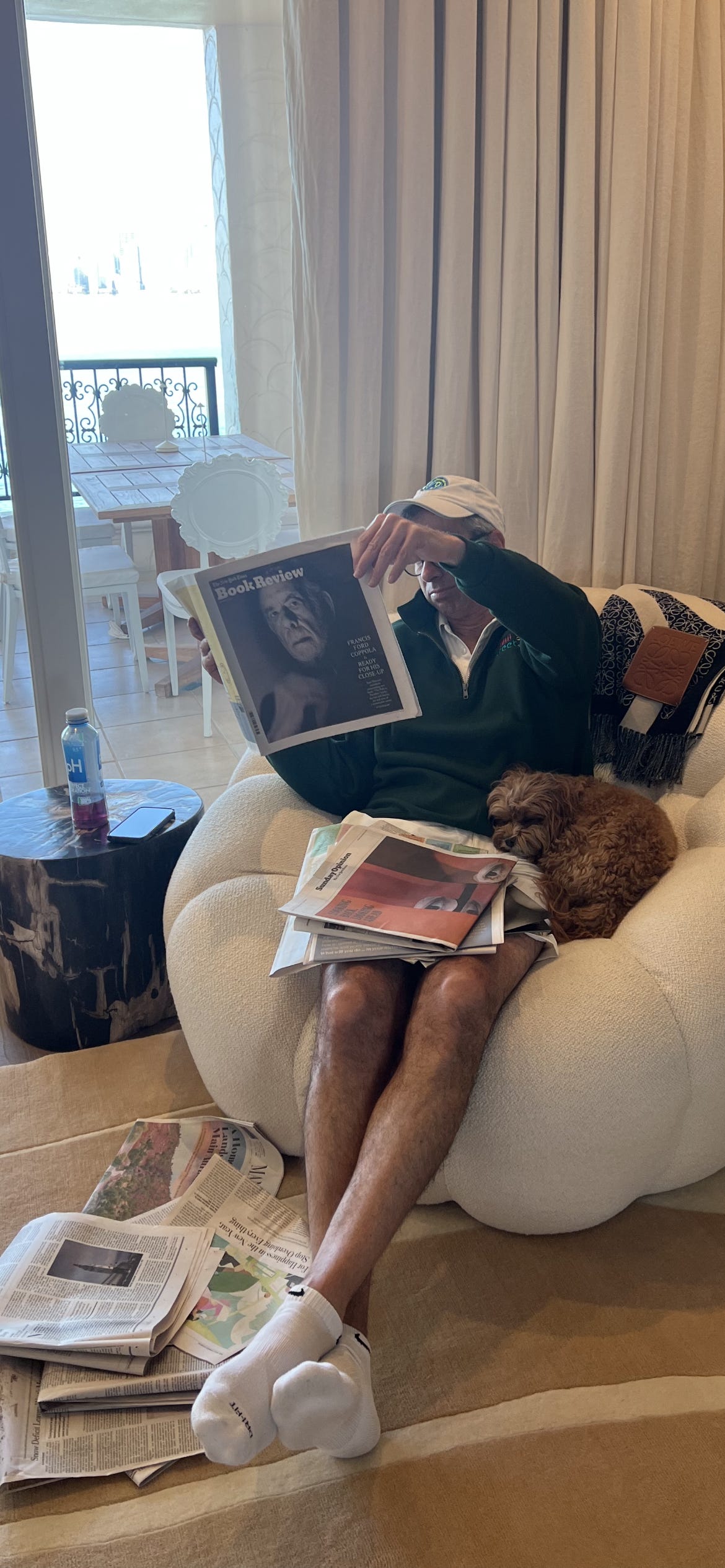
And that’s perhaps the root of it for me. There were moments over the years, many moments, when I was home, in my office, on the couch and it was just the two of us.

But with Lulu there was something else.

As a man of a certain age there are times I get up at night to go to the bathroom. And at those moments she would startle awake. And when I returned she would be there, in the night, looking at me and I would look at her and for a moment I felt a connection with this dog as if we were the only two people awake in the world and she was saying I see you, and I saw her back.

It reminds me of a stanza from a poem Jimmy Stewart wrote about his dog:

And there were nights when I’d feel this stare

And I’d wake up and he’d be sitting there

And I reach out my hand and stroke his hair.

And sometimes I’d feel him sigh and I think I know the reason why.

He’d wake up at night

And he would have this fear

Of the dark, of life, of lots of things,

And he’d be glad to have me near.

And now she’s gone.

We bought her on vacation 16 years ago when the kids were 10, 12, and 14 and they were browsing a mall pet store where the little pups were kept in cribs. She brought delight into our house and now there is hole.

So this past Sunday, once we’d made the decision, we called the kids from the veterinary hospital and for the second time in their lives FaceTimed a goodbye to a loving pet. We were drowning in tears and gratitude.

I will miss her in the middle of tonight.

Sunday, March 22, 2026

The Madness of Moms


The Madness of Moms

How a group of mothers made sense of the NCAA Tournament

CBS Sports HQ

After years of watching their sons root violently for college basketball teams with whom they had no affiliation, a group of local moms (my wife included) wanted a closer look. They marveled as the men in their lives sat forlorn over busted brackets and poor picks. So this band of boy-moms thought – knew- there had to be more.So they swapped their book club for brackets and joined the madness.​

A benevolent dad served as commissioner, sending weekly notes of encouragement to cushion the inevitable disappointment. But the moms held their own — in some cases outperforming the self-proclaimed experts at home. Their edge? They picked without emotion.

But somewhere between tip-offs and upsets, the moms discovered March Madness had less to do with basketball and more to do with life.

Your Bracket Doesn’t Actually Break - As the commissioner wisely reassured them early on, it’s almost never over after the first round. There are more games to be played, more points to be earned. Early losses don’t equal long-term failure — in brackets or in life. March is longer than you think.

Survive and Advance - That’s the enduring mantra of March. You don’t win the tournament in one game, and you rarely lose it in one either. Parenting works much the same way. So do careers, marriages, and personal goals. Success is less about dominating every matchup and more about staying in the game.

“Go Big or Go Home”(usually means going home) - Many of their sons loaded their brackets with bold, improbable upsets. The moms took a more measured approach. High risk can bring high reward — but it more often delivers early exits. Caution isn’t cowardice my son; sometimes it’s strategy.

Head Over Heart - Make your picks based on who you believe will win, even if it means going against a team you love. As one mom noted: “I suppose ignoring my kid’s schools paid off.” Tough love applies to brackets too.

Perfection Is a Myth – Don’t be so surprised by your mistakes. The odds of a perfect bracket are 1 in 9.2 quintillion. Warren Buffet offered $1 billion to anyone who achieved perfection. He’s still rich. Mistakes are not personal failures; they are statistical inevitabilities.

And perhaps most liberating of all is the randomness itself. As the commissioner conceded, deep knowledge of the game doesn’t guarantee success. Sometimes the winner is the person who picked based on mascots or school colors. There is a chaos that expertise cannot conquer.

Which leads to the final lesson: embrace the madness.

The tournament lurches between breathtaking buzzer-beaters and predictable wins. Life does the same. You celebrate what you can, absorb the losses, and fill out your bracket again next year.

In the end, these moms discovered that March Madness isn’t really about basketball. It mirrors life’s unpredictable journey – managing disappointment, calibrating risk, and staying steady when things don’t go your way.

If you can manage a busted bracket with grace, you are better prepared to handle the chaos to come.

Sunday, March 15, 2026

Is Detroit OK?

There is a way my phone rapidly buzzes from incoming text messages on any given Michigan football Saturday. It’s a touchdown, it’s a fumble, it’s a sack. Everyone needs to chime in.

I learned yesterday my phone also buzzes like that when a terrorist attacks your hometown synagogue.

I was on a call when the phone started dancing. I flipped it over:

Do you know the synagogue?
Is that near your hometown?
Are you from Bloomfield Hills or West Bloomfield?

But the very first message read: “Is DETROIT OK?”

It was from my Israeli cousins texting from their Mamad — their safe room — in Tel Aviv.

“You’re worried about us?” I texted back. “We are targets here too, but I’m worried about you. Now you be safe.”

His response: An emoji of a dancing Rabbi.


The dancing Rabbi is who I want us to be.

I could have told him Detroit is not okay.

There may not be a place of worship where I’ve attended more weddings and B’nai Mitzvot than Temple Israel in West Bloomfield. And today it joins a growing list of cities that is not okay because Jews, this time four year-olds, were targeted.

But this is not the entirety of our Jewishness.

A slew of books and Jewish leaders have said “enough.”

  • In Dara Horn’s book People Love Dead Jews, she calls for a celebration of Jewish life, not “Dead Jews Tourism.”

  • Bret Stephens in his State of World Jewry argued for focusing on Jewish joy, calling some of the fight against antisemitism a well-meaning but wasted effort.

  • In As a Jew Sarah Hurwitz argued that for many American Jews our entire existence comes through trauma: the Holocaust, antisemitism and holidays which focus on historical persecution.

In a few weeks we celebrate Passover, my favorite holiday focused on family, tradition and freedom.

Yes, the story begins with oppression. But that’s not where it ends.

So I would say: “No — Detroit is not okay.”

The war is here.

But so is Passover.